Last updated November 18, 2026




Free written scope consultation - allowances, timeline, and change-order rules on paper before a single trade is scheduled
Driveway & Pavers Troubleshooting in Berkeley: Common Problems and How to Fix Them
If you’ve had a contractor reset sunken pavers twice in three years and they keep sinking, the pavers aren’t the problem. Something in the base or the drainage system is failing, and resetting the surface is just postponing the real repair. In our experience across Berkeley, the same two root causes show up over and over: an undersized base that ignored local soil conditions, and drainage designed for a drier climate than the one we actually live in. This guide walks through how to read each symptom, separate a cosmetic fix from a structural one, and decide when an incremental repair is throwing money at a compromised system. You’ll learn how to diagnose base failure versus sand migration, sort real efflorescence from underspec’d material, and handle the aggressive street trees that push roots under Berkeley driveways.
Quick Answer
Most paver problems in Berkeley come down to one of two failures: a base that was built too thin or on poorly compacted soil, or drainage that can’t handle sustained wet-season runoff. Sinking that comes back after every reset almost always points to base failure, which requires excavation and rebuild rather than surface patching. Sand washout, minor efflorescence, and isolated displacement can often be corrected without a full demo, but you need to read the displacement pattern to know which you’re dealing with.
Styles & brands we work with
- Kitchen remodeling
- Bathroom remodeling
- Home additions & ADU
- Roofing
- Windows & doors
- Driveway & pavers
- Fence
Table of Contents
- How Do You Diagnose a Paver Problem in Berkeley?
- Base Failure vs. Sand Migration: Reading the Pattern
- Why Berkeley’s Wet Winters Wreck Joint Sand (and What Holds Up)
- Efflorescence and Spalling: Cosmetic or Structural?
- Tree Root Intrusion and the Street Trees That Cause It
- Drainage Problems Specific to Berkeley Lots
- When a Repair Should Trigger a Full Rebuild
- Choosing Materials That Survive Here
How Do You Diagnose a Paver Problem in Berkeley?
A paver problem is diagnosed by where the failure starts, not where it’s visible. The visible symptom is almost always at the surface, but the cause is usually below it. In Berkeley, the wet-season cycle of rain, saturation, and slow drying puts continuous stress on the base course and the joint sand, so failures that would take years in a drier climate show up in a season or two.
Start by mapping the displacement across the whole driveway rather than staring at the one sunken spot. Grab a straight edge, a level, and a hose. Walk the driveway and note where pavers are low, where water pools after you run the hose for a few minutes, and whether joints are open or filled. Then push a screwdriver or thin probe into an open joint to check how deep the sand layer runs and whether it’s compact or loose.
Follow this sequence:
- Map the low points. Mark every dip with chalk. A single isolated low spot suggests local settlement or sand migration. A broad, spreading depression suggests the base is failing.
- Watch how water moves. Run water and observe. If water sheets off the driveway to the street, drainage is working. If it pools in the middle or backs toward the house, the slope is wrong.
- Probe the joints. Loose sand that drains away with a small amount of water points to joint sand washout. Sand that stays packed but has open gaps above it points to subsidence.
- Check the edges. Edge restraints that have shifted outward allow pavers to spread and joints to open. Look for paver creep at the driveway perimeter.
- Look upslope. Water arriving from a slope, a downspout, or a neighboring property often causes a localized failure that gets misdiagnosed as a “bad paver.”
In Berkeley, slopes are the rule rather than the exception, and driveways on hillside lots routinely receive water from an uphill neighbor’s runoff. If a repair fails a second time in the same spot, check what’s feeding that spot before blaming the pavers.
Base Failure vs. Sand Migration: Reading the Pattern
Base failure and sand migration look identical in a photograph and get treated very differently on a job site. The distinction matters because one is a patch and the other is a rebuild, and confusing them is how homeowners end up paying twice for the same repair. Sand migration means the bedding layer has shifted or washed out, but the compacted base course underneath is still sound. Base failure means the compacted aggregate itself has lost its integrity.
Here’s how the pattern reads:
- Sand migration: displacement is shallow and localized. The pavers rock slightly underfoot, joints open over a small area, and pushing the pavers back with light pressure often restores the surface temporarily. The dip is usually under an inch.
- Base failure: the depression spreads over weeks or months, pavers sink more than an inch, and the area around the sunken spot often shows cracking or rutting. Pavers in the affected zone feel unsupported, and tapping with a mallet produces a hollow sound under multiple pavers.
- Edge migration: joints open in a fan pattern pointing away from a specific edge. This is a restraint failure, not a base failure, but it can progress to one if not corrected.
- Differential settlement: one section of the driveway sits lower than an adjacent section. This almost always indicates a base issue or underlying soil condition rather than a bedding problem.
The most reliable field test is excavation. Lift two or three pavers at the low point and look at what’s underneath. If the bedding sand is thin, loose, or absent but the aggregate below is firm and well-graded, it’s sand migration – fixable without a full demo. If the aggregate is muddy, uncompacted, or contains organic material, the base needs to be rebuilt. In our experience, driveways that fail repeatedly after resets are being diagnosed at the surface when the real issue is two or three inches deeper. For a full picture of how a properly built driveway is layered, see our main driveway & pavers page.
Why Berkeley’s Wet Winters Wreck Joint Sand (and What Holds Up)
Joint sand washout is the single most common paver complaint we hear in Berkeley, and the reason is straightforward: our wet-season rain delivers sustained moisture over months, not short bursts. Standard joint sand that’s marketed for drier climates relies on fast drainage and quick drying to stay locked in. In Berkeley, the joints sit wet for days or weeks at a stretch, and that sustained moisture slowly flushes the fines out of the joint, leaving gaps that widen season over season.
The fix isn’t just to re-sand with the same product and hope it holds. Joint sand has to be chosen for how it performs under continuous moisture. Polymeric sand that cures into a flexible, water-resistant joint typically holds up best in this climate, but not all polymeric formulations are equal.
What to look for in a climate like Berkeley’s:
- Flexible polymeric sand: cures with some give so the joint rides minor movement without cracking. Better for driveways that see vehicle loads.
- Water-activated vs. air-activated formulations: water-activated polymers set up when wetted, which suits a climate where the joint will be wet repeatedly. Air-activated products rely more on drying, and drying is what Berkeley’s wet season is short on.
- Finish texture: “haze-free” or “matte” finishes reduce the cloudy surface film that plagues polymeric installs in wet climates.
- Drainage design: even the best joint sand fails if water can’t leave the driveway. Sand washout on a slope is often a symptom of a drainage problem rather than a joint-sand problem.
If your joints are washing out every season, don’t just top them off each fall. Look at what’s driving the washout first – slope, edge restraint, or missing drainage – and correct that before re-sanding. New joint sand over a failed drainage system will wash out again within a season or two.
Efflorescence and Spalling: Cosmetic or Structural?
Efflorescence is the white, chalky bloom that appears on paver surfaces, and it’s usually cosmetic. It happens when moisture moves through the paver and evaporates at the surface, leaving dissolved salts behind. In Berkeley’s wet climate, moisture movement through pavers is common, so efflorescence shows up more often here than in drier regions. Most of the time it can be cleaned with a proper efflorescence remover and a sealer applied afterward to slow its return.
Spalling is different. Spalling means the paver surface itself is flaking or popping off in layers. That’s a material failure, not a surface stain, and it usually points to one of three things:
- Underspec’d paver material: a paver with insufficient density or a surface texture that wasn’t rated for the moisture environment it’s installed in.
- Manufacturing defect: a batch defect that shows up as flaking across a specific area rather than randomly across the driveway.
- Improper installation: pavers installed too wet, without proper compaction, or with a bedding layer that traps water under the surface.
The test is simple. If the white bloom wipes off and returns slowly, it’s efflorescence. If the surface texture is physically flaking or chipping away, it’s spalling, and no sealer will fix it. Sealer on a spalling paver actually makes the problem worse by trapping moisture that accelerates the failure.
On steep warm-slope driveways that see a lot of sun, spalling is sometimes misread as sun damage. In practice, spalling in Berkeley is more often a sign the paver was underspec’d for our moisture. If you’re replacing a spalling paver, look at product lines rated for sustained wet climates. The paver brands we install, including Belgard, Unilock, and Techo-Bloc, are chosen in part for how they perform under real moisture rather than dry-climate test conditions.
Tree Root Intrusion and the Street Trees That Cause It
Tree roots are one of the most under-diagnosed causes of paver failure in Berkeley, and they’re also one of the most expensive to fix after the fact. The problem shows up as a rising or tilting section of pavers, often with joints that open in a radial pattern pointing back toward a tree. If a repair contractor doesn’t trace the displacement to a root, the fix will fail – the root will keep growing and re-lift the pavers within a couple of seasons.
Not all street trees in Berkeley are equally aggressive. Liquid amber (sweetgum) and sycamore are the two species we most often see driving paver displacement here. Both have shallow, spreading root systems that find their way under driveways and along fence lines, and both grow roots aggressively where the surface is warm and where water is available under the paving.
How to handle root intrusion:
- Identify the source tree. Trace the displacement pattern to the nearest tree. If it’s on a city right-of-way, there are rules about what can be cut, and cutting a public tree without permission can create a bigger problem than the driveway itself.
- Get an arborist assessment before cutting. Cutting a major structural root can kill the tree or make it unstable. A certified arborist can tell you which roots are safe to remove and which require a different strategy.
- Rebuild the affected section with a root barrier. A properly installed root barrier along the affected edge, driven to a depth that matches the tree’s root habit, gives the driveway a defensible perimeter that redirects growth away from the base.
- Modify the base where roots are known. On a driveway near a large liquid amber, a heavier base with a geotextile separation layer can absorb minor root pressure without losing surface integrity.
For fences and other exterior structures, aggressive roots create the same problem, which is why we plan root management alongside our fence installation work rather than after the fact. Any hardscape near a mature tree needs a root strategy from day one.
Drainage Problems Specific to Berkeley Lots
Drainage is the second half of the paver failure equation in Berkeley, and it’s the half most often ignored. Berkeley’s hillside lots are cut into slopes, which means water arrives at the driveway from more than one direction: from the street below, from uphill neighbors, from the slope above the house, and from the house’s own downspouts and runoff. A driveway that drains well in the dry season can flood the base in the wet season because the paths water takes change when the ground saturates.
Common drainage failures we see in Berkeley:
- Back-sloped driveways: pavers sloped toward the house rather than the street, which lets water pool at the garage door or stairwell. Most codes require driveway slope to move water away from the structure, but the requirement gets missed during installation.
- Insufficient cross-slope: driveways on flat lots need a cross-slope to move water sideways to a drain or landscape edge. Without it, water sheets into the base.
- Missing or buried drains: channel drains, French drains, and area drains that were installed once and never maintained. Buried drains are functionally blocked drains.
- Downspout discharge: a downspout that empties onto the driveway surface deposits water right where it does the most damage. Rerouting downspouts to a planted area or a drywell is often the cheapest fix in the whole guide.
- Uphill runoff from neighboring properties: a common problem in Berkeley’s hillside neighborhoods. The fix involves surface grading, a swale, or a retaining solution, and it deserves a real conversation rather than a quick patch.
If your driveway drains toward the street when it rains, drainage is likely fine and joint sand washout is a secondary symptom. If water sits, backs toward the house, or pools over a joint line, the base is being soaked and will fail. That’s the point where a repair plan needs to include drainage work, not just paver work.
When a Repair Should Trigger a Full Rebuild
Troubleshooting becomes a full rebuild decision the moment you find two or more of these red flags. Incremental fixes on a compromised system are the most expensive way to own a driveway, because each repair resets the clock by a season while the underlying problem keeps progressing. Knowing when to stop repairing and start rebuilding is the single biggest cost decision in paver ownership.
Red flags that push past repair:
- Repeat failure in the same area. If the same section has been reset twice or more, the base is failing there regardless of what the surface looked like when the repair was done.
- Spreading depression. A dip that was a foot across and is now three feet across is a growing base failure.
- Multiple failures across the driveway. One bad spot is a repair. Four bad spots usually means the base was uniformly underbuilt.
- Edge settlement beyond the pavers. If the driveway edge is dropping and the soil around it is settling, the subgrade is the problem, not the pavers.
- Substantial root intrusion across a section. When root networks have colonized the base, the paver layer can’t be re-established over them without root corrections.
- Drainage that can’t be fixed without re-grading. If water management requires a slope change, the pavers have to come up regardless.
- Spalling across more than a small area. A material that’s failing on too much of the surface should be replaced, not patched.
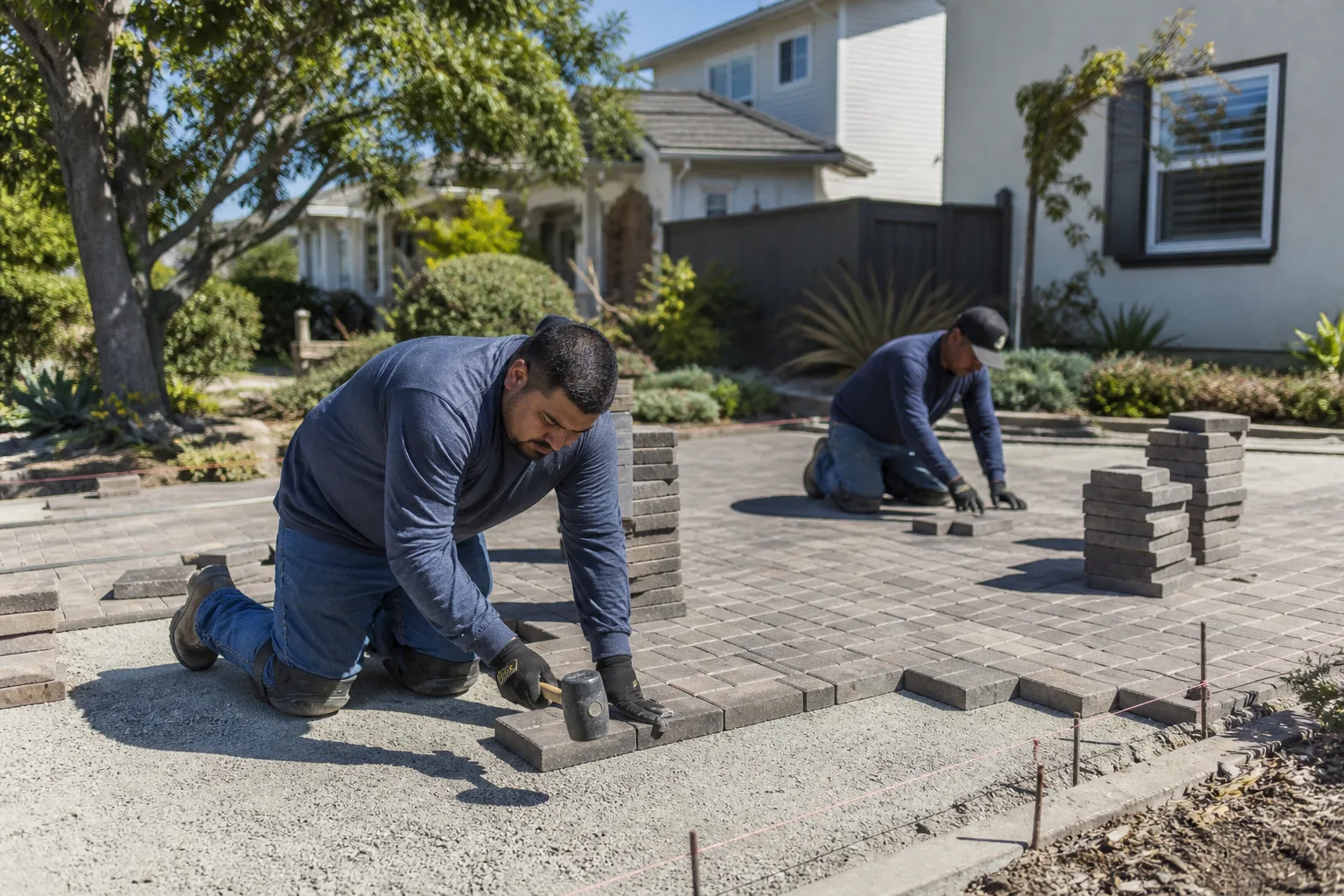
A full rebuild isn’t always the more expensive path in the long run. Two or three surface repairs on a failing base add up. And when a rebuild does go in, the base, drainage, and edge restraint can all be corrected at once – which is the only way to keep a driveway in place. For larger exterior planning that goes beyond the driveway, our home additions & ADU work often includes hardscape coordination so the exterior opens up consistent with a new addition.
Choosing Materials That Survive Here
The right paver for Berkeley is a paver chosen for sustained moisture, not for how it looks in a showroom sample. That’s the difference between a driveway that holds up over a decade of wet winters and one that shows efflorescence and spalling after the first two. Material selection drives more of the long-term outcome than most homeowners realize, and it’s the part of the project most easily compromised by a bid with a substituted product.
What to look for when choosing pavers here:
- Low water absorption: pavers with low absorption rates resist freezing, spalling, and efflorescence better in a wet climate, even without freezing winters.
- Manufacturer warranties: premium paver brands carry product warranties independent of the installation, which gives you a source of recourse if a material issue shows up. Belgard, Unilock, and Techo-Bloc all have lines built for sustained moisture, and their warranties back it up.
- Correct bedding sand and joint sand: the paver is only as good as what’s under it and between it. Filter fabric, well-graded bedding sand, and a moisture-rated polymeric joint sand do more for long-term performance than paver color does.
- Compaction equipment, not hand tamping: base compaction is a measurement, not a motion. Proper compaction of the base course is the largest single factor in whether the driveway stays in place.
- Edge restraint: the hidden structural element that stops pavers from creeping. Restraint failure is behind a large share of “my pavers are spreading” complaints.
We source pavers from premium brands because manufacturers with real climate testing publish real performance data. That said, the right paver for your driveway depends on slope, sunlight, water flow, and traffic. A material that performs on a flat lot near the flats may not be the right selection on a shaded, tree-heavy slope near the hills. For homeowners weighing paver brands or comparing a paver driveway against other surfaces, our driveway & pavers service page covers material choices in more depth.
Common Mistakes to Avoid
- Resetting pavers on a failed base. If the base is uncompacted or saturated, resetting the pavers just postpones the failure by a season or two. Diagnose the base before you reset the surface.
- Topping joint sand without fixing the drainage. New sand on a sloped driveway that sheds water badly will wash out again within a season. Fix the slope or add a drain first.
- Sealing a wet driveway. Sealer traps moisture. In Berkeley, sealing during or just after the wet season traps water under the sealer and accelerates efflorescence and spalling. Seal only after a dry spell.
- Cutting structural tree roots without an arborist. Big-root removal on liquid amber or sycamore can destabilize the tree and sometimes the adjacent soil. Get the assessment before the saw.
- Buying pavers by color instead of absorption rating. A beautiful paver with a high absorption rate will not hold up in a wet Berkeley winter regardless of how well it’s installed.
- Skipping edge restraint. Without edge restraint, pavers spread over time and joints open across the entire driveway. It’s a small line item that prevents a large problem.
- Assuming every white bloom is cosmetic. Efflorescence wipes off. Spalling flakes off. One is a surface clean, the other is a material failure, and treating them the same makes the spalling worse.
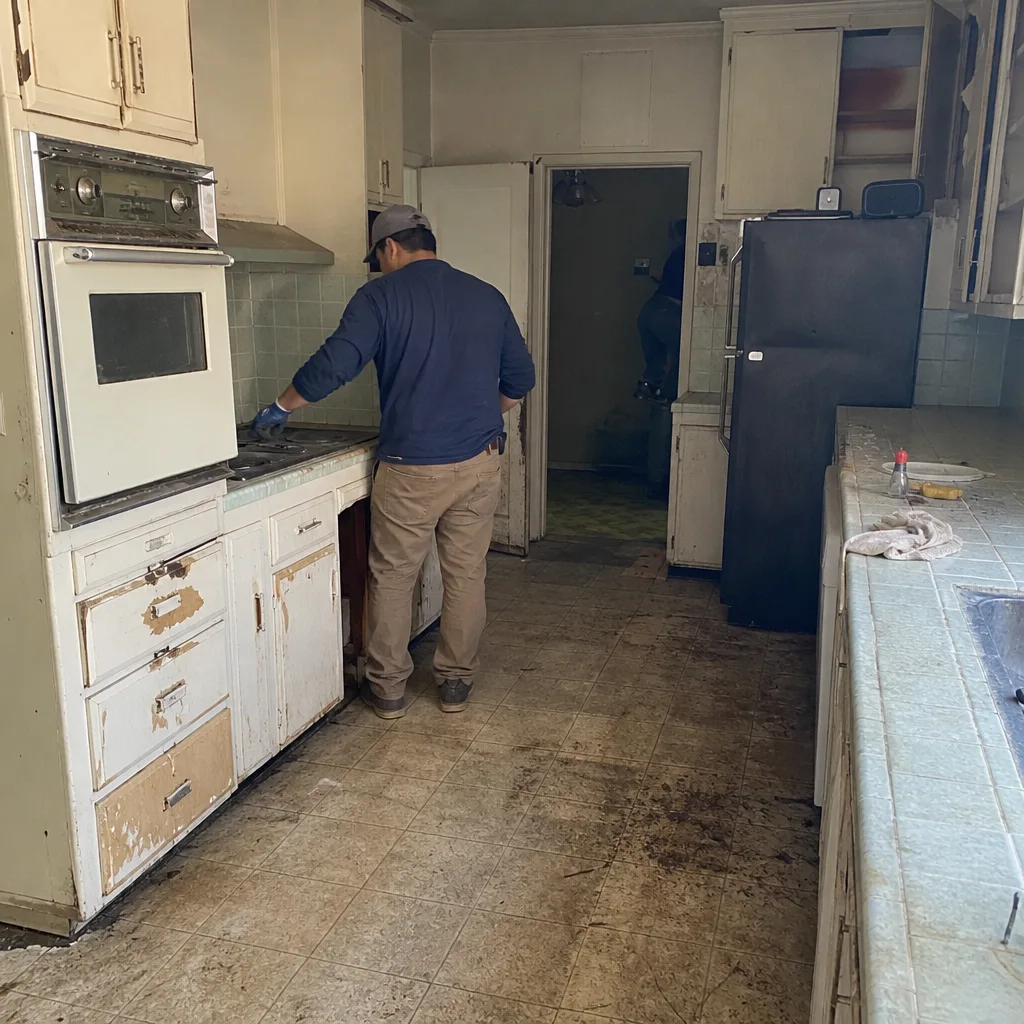
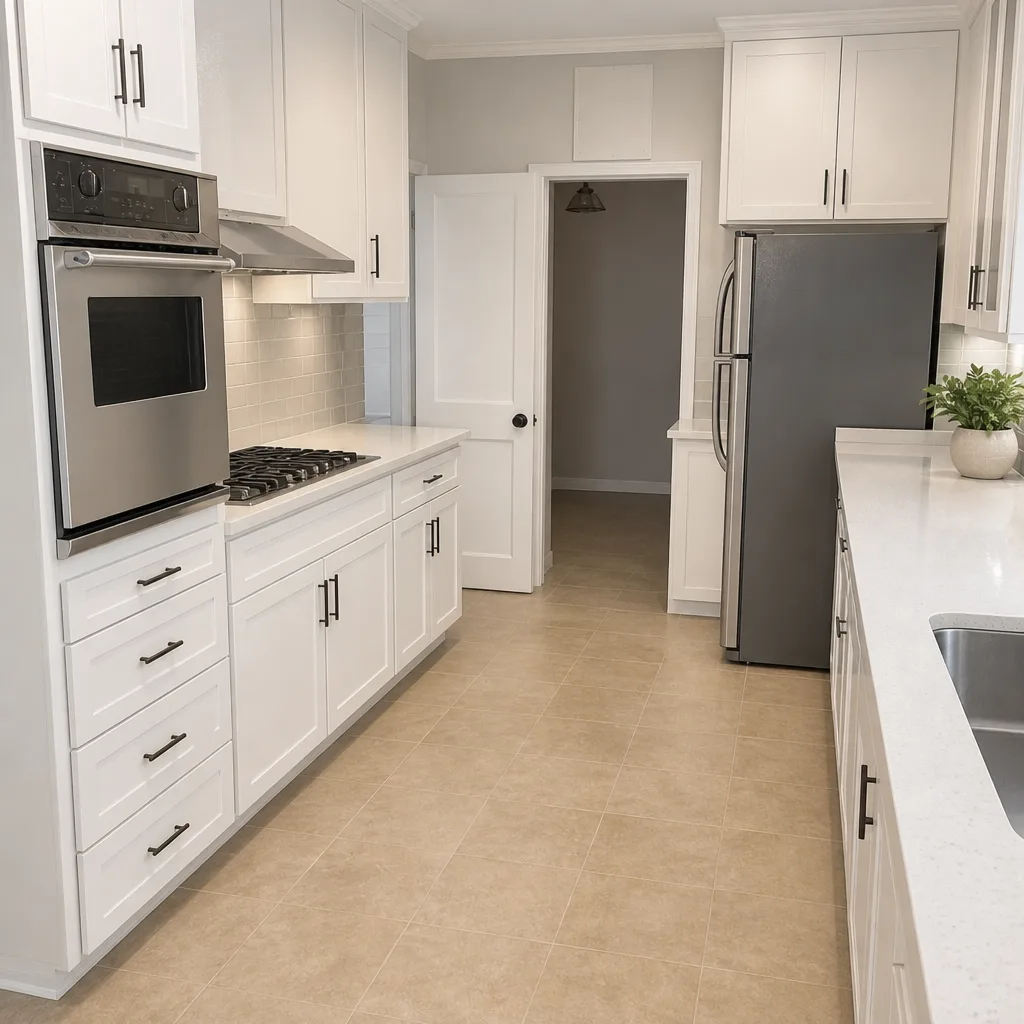
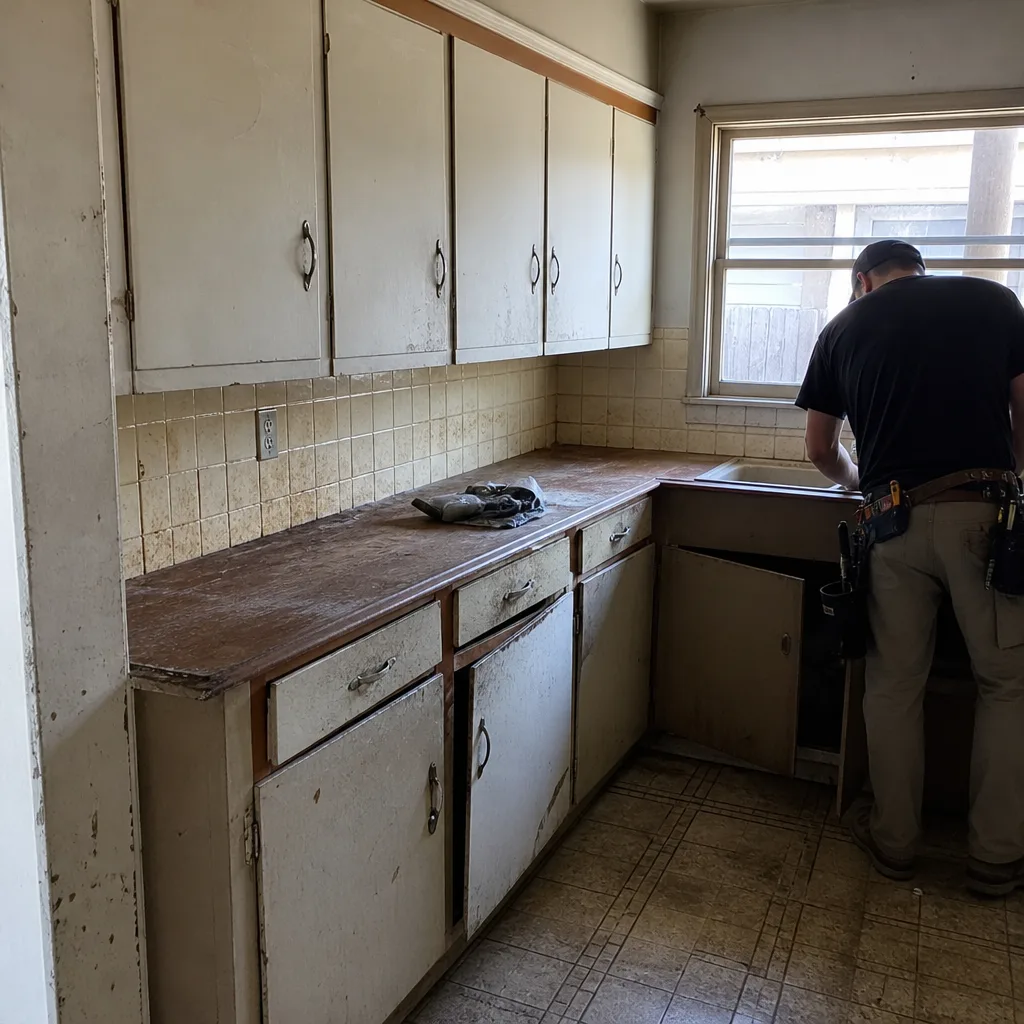
See the difference
 Before
 After
 Before
 After
 Before
 After
When to Call a Professional
Call in a professional when the pattern you see doesn’t fit a simple repair. If a dip has come back after being reset, if water pools on the driveway rather than running off, if the surface is flaking rather than staining, or if a mature tree is lifting a section of pavers, those are all situations where the fix depends on what’s below the surface and a misdiagnosis costs real money. The same is true if you’re facing a rebuild rather than a repair – the base, drainage, and materials need to be selected together, and the job only goes right when they are. A full assessment of a paver driveway costs less than another round of surface repairs that fails the following season. Our technicians have up to 9 years of experience diagnosing exactly these failures.
Construction Berkeley offers free estimates in Berkeley and across the surrounding area. Call (844) 797-8850 to schedule your free estimate. We answer 24/7. Fast dispatch from 7am to 7pm, Sunday through Friday.
Frequently Asked Questions
Typical repair costs depend entirely on which failure you’re looking at. A localized re-sand and reset is usually in the hundreds of dollars, while a partial rebuild that excavates the base in a single area runs higher because of the excavation, aggregate, and compaction work. A full driveway rebuild is a larger line-item project and varies with driveway size, base depth required by the soil conditions, and drainage scope. The written estimate sets the final price, and we provide free estimates so you know what you’re looking at before any work begins. Call (844) 797-8850 for an exact quote – estimates are free.
Pavers keep sinking because the base beneath them is failing, not because the pavers are loose. Resetting restores the surface temporarily, but the compacted aggregate under the pavers has lost its integrity, so it settles again under load and moisture. The only fix that holds is to excavate the affected area, correct the base, and reinstall the pavers. If the sinking is coming back in the same spot within a season or two, base failure is the diagnosis regardless of what the previous repair looked like. Call (844) 797-8850 to schedule a free estimate.
White powder on pavers is usually efflorescence, a surface salt bloom that forms when moisture moves through the paver and evaporates at the surface. It’s cosmetic in most cases and can be cleaned with an efflorescence remover, followed by a sealer after a dry spell to slow its return. If the surface is flaking or popping off in layers rather than just showing white bloom, that’s spalling, and it’s a material issue rather than a surface stain. Call (844) 797-8850 for an exact quote on diagnosis and repair – estimates are free.
Yes, and root intrusion is one of the most common causes of paver displacement in Berkeley, especially near liquid amber and sycamore street trees. Roots find the warm, moisture-rich environment under the paving and lift pavers from below, opening joints and creating a fractured surface. The right fix depends on whether the tree is on your property or a city right-of-way, and major roots shouldn’t be cut without an arborist assessment. A defensible perimeter with a root barrier is usually part of the plan. Call (844) 797-8850 to schedule a free estimate.
Most cities require a permit for driveway work that changes grading, drainage, or the connection to the street, and Berkeley’s rules can apply to hardscape that touches the public right-of-way. The exact requirements depend on your project scope and lot, so the county or city building department is the source of truth. Ask before you sign a contract, so the permit scope and inspection plan are set from the start. Call (844) 797-8850 for an exact quote on the hardscape work – estimates are free.
A localized repair that corrects surface sand and a small displaced area is generally a short job, while a rebuild that excavates the base, addresses drainage, and reinstalls the full paver surface takes longer because the base course has to cure and compact properly before the pavers go back down. The timeline for your project depends on the driveway size, the scope of drainage work, and any material lead times. We set the schedule in the written estimate so you know the plan before work starts. Call (844) 797-8850 to schedule a free estimate.
The Bottom Line
Most paver problems in Berkeley have a diagnosable cause, and the cause is almost always below the surface. Sunken pavers that keep coming back point to a base that needs to be excavated and rebuilt, not reset again. Joint sand that washes out every wet season points to a drainage problem or a joint-sand product that isn’t rated for sustained moisture. White bloom that wipes off is cosmetic, while flaking surfaces mean the material was underspec’d for the climate. Tree roots – especially from liquid amber and sycamore – need an arborist-informed plan and a root barrier, not a saw. And when two or more structural red flags show up on the same driveway, the rebuild is the smarter spend than another round of repairs. Construction Berkeley installs premium paver brands chosen for how they perform in real moisture, and we build the base and drainage to match. If you’re looking at a paver problem that has already been repaired once, a free assessment is the right next step.
Call (844) 797-8850 for a free estimate. We answer 24/7. Fast dispatch from 7am to 7pm, Sunday through Friday. To see the full scope of what we do across the exterior and interior of a home, start at Construction Berkeley.
Written by the team at Construction Berkeley.